Women's pelvic health · Northern California
Pelvic floor physical therapy for women in Northern California, by video.
Pregnancy and postpartum recovery, bladder and bowel symptoms, prolapse, and pelvic pain. One-on-one with a Doctor of Physical Therapy who specializes in pelvic health, from home anywhere in Northern California.
- Private pay with superbills for out-of-network reimbursement
- No referral needed for the first 45 days or 12 visits
- Usually seen within a week

Women's pelvic health
What this is, and who it is for.
About one in four women in the United States lives with at least one pelvic floor disorder, and most never see a specialist. The pelvic floor is a group of muscles at the base of the pelvis that supports the bladder, uterus, and bowel and works with the diaphragm and deep abdominal muscles every time a person breathes, lifts, coughs, or runs. Pregnancy, childbirth, surgery, menopause, and years of habit change how those muscles coordinate, and that shows up as leaking, heaviness, pain, or urgency.
Pelvic floor physical therapy treats those muscles the way orthopedic physical therapy treats a shoulder: assess how they are working, retrain coordination, strength, and relaxation, and build a short daily program the patient can keep up. Clinical guidelines recommend pelvic floor muscle training as first-line care for urinary incontinence and for pelvic organ prolapse, before medication or surgery.
The Bay Area has pelvic health specialists with long waits and Bay Area prices; the Central Valley, the North Coast, and the far north have almost none. A video visit gives someone in Fresno, Redding, or Eureka the same specialist as someone in Palo Alto, from home.
What we treat
Conditions we see in Northern California
Each condition has its own page with what it is, what the evaluation looks at, and how the program is built.
Pregnancy and after birth
- Postpartum recovery
- In France and much of Europe, pelvic floor rehab after birth is routine. In the United States, most women get a six-week check and...
- Pregnancy pelvic and back pain
- About half of pregnant women have pelvic girdle or low back pain, and most are told it is normal. It is common, but it is treatable, and...
- Diastasis recti
- Diastasis recti is a widening of the gap between the two halves of the rectus abdominis. It happens in most pregnancies, and physical...
- C-section recovery
- A cesarean is major abdominal surgery, and most women are sent home with no rehab plan at all. Scar care, core retraining, and pelvic...
Bladder and bowel
- Urinary incontinence
- Leaking with a cough, a sneeze, a jump, or on the way to the bathroom affects about one in three women at some point. It is common, it...
- Overactive bladder, urgency and frequency
- Running to the bathroom ten times a day, waking twice a night, and the sudden urge that comes out of nowhere are the signs of an...
- Pelvic organ prolapse
- Prolapse is when the bladder, uterus, or rectum drops lower in the pelvis. About half of women who have given birth have some degree of...
- Constipation and bowel dysfunction
- Chronic constipation and straining are often a muscle coordination problem, not a fiber problem. When the pelvic floor tightens instead...
Pain and recovery
- Painful intercourse
- Pain with intimacy is one of the most common and least discussed pelvic floor problems. It is usually driven by muscles that have...
- Chronic pelvic pain
- Pelvic pain that has lasted more than six months almost always involves the pelvic floor muscles, whatever started it. Treating those...
- Menopause pelvic health
- Falling estrogen changes the pelvic floor, the bladder, and the vaginal tissue. The leaking, urgency, dryness, and heaviness that follow...
- Recovery after pelvic surgery
- Hysterectomy, prolapse repair, bladder sling, and endometriosis surgery all change how the pelvic floor and core work. A structured...
Coverage in California
Insurance and pricing
Bring your plan name to the discovery call and we confirm your physical therapy benefit before the first visit.
Private pay
Visits in California are private pay. We provide a superbill you can submit to your insurer for out-of-network reimbursement. HSA and FSA cards accepted. Rates are quoted on the free discovery call.
Referrals
California allows you to start physical therapy without a referral for up to 45 days or 12 visits. If care continues beyond that, we help you get a signed plan of care from your physician.
The Bay Area, Sacramento, the Central Valley, the North Coast, the Sierra foothills, and the far north are seen by video, including military families at Travis AFB and Beale AFB.
How it works
How a virtual visit works
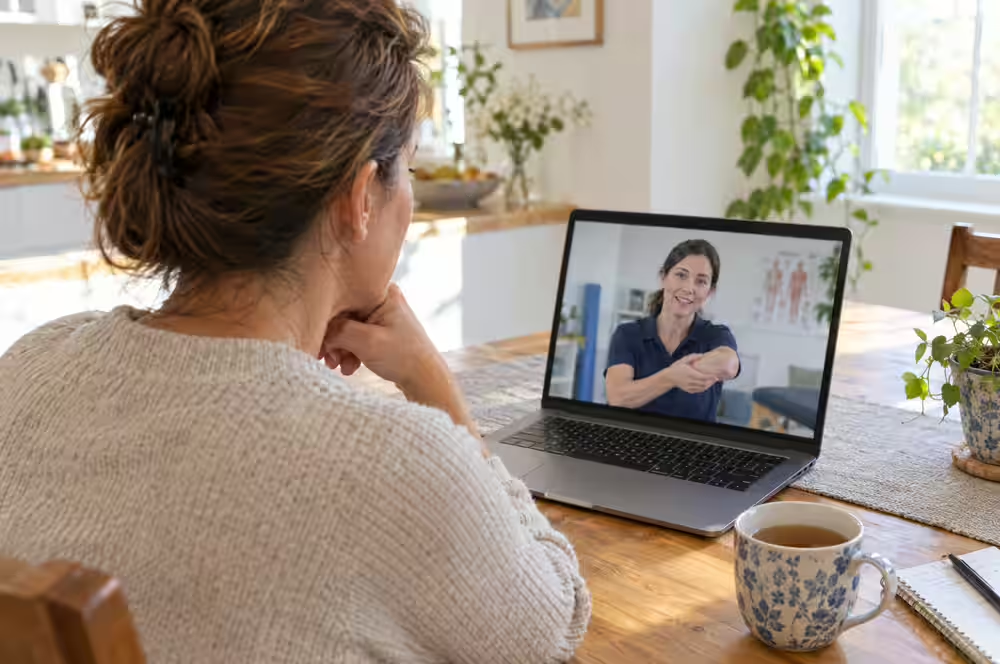
Most of pelvic floor physical therapy is education, breathing and pressure management, movement retraining, and a home program. All of it works on camera. During the evaluation, Dr. Shalem guides a self-assessment so she can see how the pelvic floor is coordinating with breath and movement. An internal examination is not possible by video; if a hands-on assessment would change the plan, she says so and helps the patient find local care.
Discovery call
15 minutes, free, by phoneA short call to hear what is going on, explain how visits work, and check insurance or pricing. No pressure to book.
Evaluation
60 minutes, by videoDr. Shalem takes a full history, watches how you move and breathe, and guides the self-assessments she needs to build a plan.
Your plan
Same visitYou leave the evaluation with a plain-language explanation and a short home program, usually a few minutes a day.
Follow-ups
45 minutes, every 1 to 2 weeksProgress checks, program updates, and techniques you can do yourself, for as long as they are useful.
For a video visit you will need
- A phone, tablet, or laptop with a camera
- A private room
- A mat or towel
- About an hour
Questions
Women's pelvic health questions in Northern California
Does pelvic floor physical therapy work over video?
Much of it is education, breathing and pressure management, movement retraining, and a home program, and all of that works on camera. During the evaluation Dr. Shalem guides a self-assessment so she can see how the pelvic floor is coordinating. An internal examination is not possible by video. If a hands-on assessment would change the plan, she will say so and help you find local care.
How many visits does pelvic floor physical therapy usually take?
Most plans run six to twelve visits over two to three months, with a short home program between visits. The evaluation sets the plan, and it is adjusted as things change.
Is it only for women who have had children?
No. Pelvic floor symptoms affect women who have never been pregnant, athletes, women in perimenopause and after menopause, and women recovering from pelvic or abdominal surgery.
What happens at the first visit?
A 60-minute video evaluation: a full history, a look at posture, breathing, and movement, and a guided self-assessment of the pelvic floor. You leave with a plain-language explanation and a first home program.
Do I need a referral for physical therapy in California?
California allows you to start physical therapy without a referral for up to 45 days or 12 visits. If care continues beyond that, we help you get a signed plan of care from your physician.
What insurance do you take in California?
Private pay: Visits in California are private pay. We provide a superbill you can submit to your insurer for out-of-network reimbursement. HSA and FSA cards accepted. Rates are quoted on the free discovery call.

Your physical therapist
Dr. Elana Shalem, DPT
Doctor of Physical Therapy, University of St. Augustine for Health Sciences, Miami. Licensed in California.
Dr. Shalem treats pelvic health for women and men, from pregnancy and postpartum recovery to bladder, bowel, and pelvic pain conditions and recovery after prostate or pelvic surgery, and general orthopedic conditions of the back, neck, hips, knees, shoulders, and feet. Visits are one-on-one and unhurried, and she explains what she is seeing in plain language.
More about Dr. ShalemPrefer to write? Send a message.
Questions about insurance, pricing, or whether physical therapy is the right next step? We reply within one business day.
Start with a free 15-minute call.
Tell us what is going on, hear how Dr. Shalem would approach it, and decide from there.